

Everyone should go read Scott Alexander’s remarkable post about donating his kidney (if you haven’t already). One question he raises is why so many effective altruists donate a kidney, given that it “has an unusually high ratio of photogenic suffering to altruistic gains.” (Most of us would find it a lot easier to instead make a kidney-equivalent donation of $$ to good causes.) But, as he notes towards the end of the post:
Coalition To Modify NOTA [to provide tax incentives to encourage more widespread kidney donation] is full of previous living kidney donors, who are using the moral clout and recognition they’ve gotten to get attention and change the system in an unglamorous way. I find this an admirable way of squaring the circle: do the flashy heroic things to gain social capital, then spend the social capital on whatever’s ultimately most important.
A decade ago, Alexander Berger got a NY Times op-ed selling the idea of selling kidneys out of his own altruistic donation. So that was awesome. But it is striking that most the expected benefit here turns out to be indirect: more from the publicity for a good policy proposal than the good done for the immediate kidney recipient (though the latter is certainly also good!).
This got me thinking. Suppose someone was prepared to donate a kidney, but then at the last minute, instead of letting it go to the recipient, they insisted on burning it.
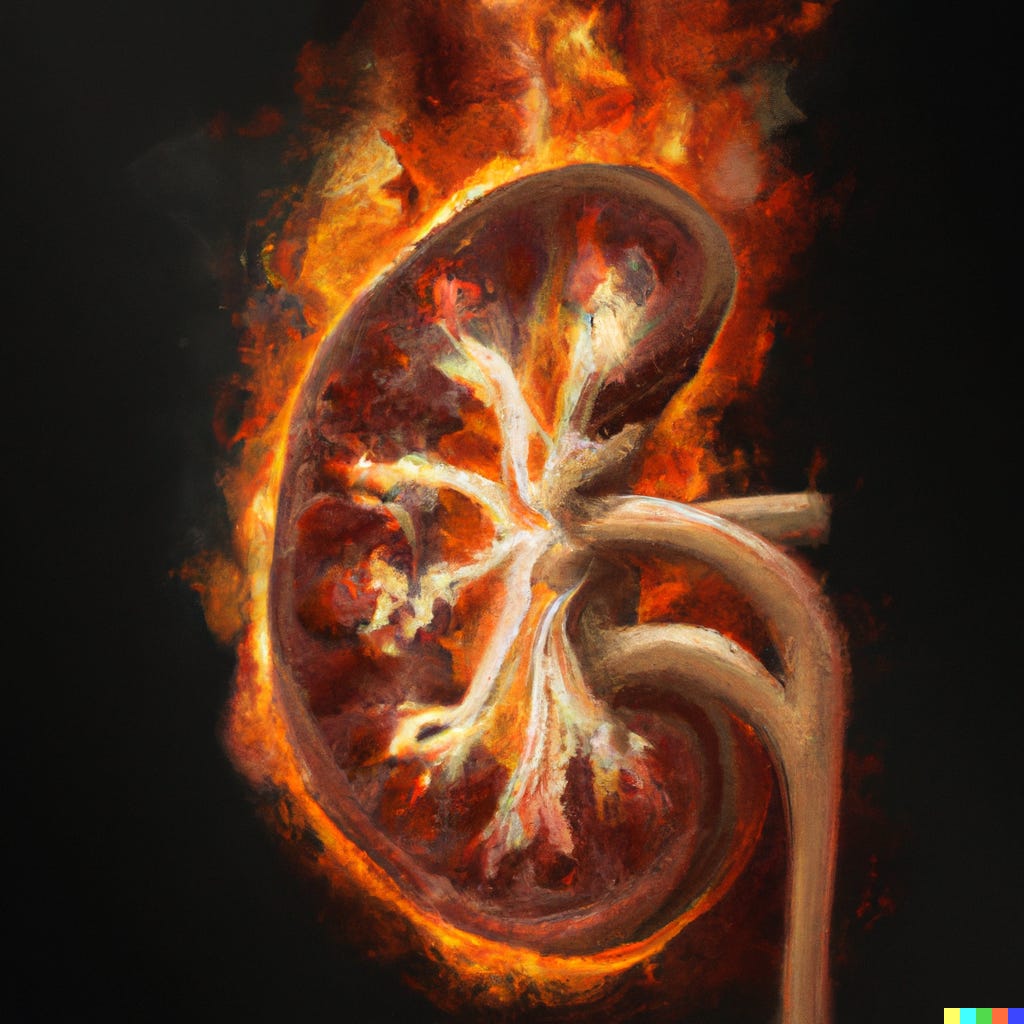
Seems messed up! But now imagine that the would-be donor has a story to tell. Their act of horrendous, gratuitous wastefulness was an act of protest to draw attention to the gratuitous wastefulness of our current policy situation. After all, they point out, having the government pay for kidneys would:
(1) Save taxpayers money, compared to what the government pays for dialysis.
(2) Greatly benefit dialysis patients, who desperately need more kidneys to be made available for transplantation. And also:
(3) Benefit the new donors, who are keen to go through a medical process that’s comparable in risk to childbirth if sufficiently well compensated.
Our current policy harms all three groups, by comparison, for no good reason. It’s the moral equivalent of burning kidneys by the bus load. However horrified you are by this lone individual gratuitously burning their kidney when it could have saved someone, you should be all the more horrified by government policies that gratuitously deprive thousands of the kidneys that they need.
"However horrified you are by this lone individual gratuitously burning their kidney when it could have saved someone, you should be all the more horrified by government policies that gratuitously deprive thousands of the kidneys that they need."
Well, the government's intervention is in some sense more causally *distal* to the sick person eventually not getting the kidney than would be the burning-action. Thus by (I conjecture) widely-held principles of penalizing harm in-proportion-to some notion of its causal proximity, it's not as bad.
I would expect deontologists to be furiously working on trying to elaborate such accounts. Somehow I don't observe them doing that.
I know this post is a bit old now, but still…
When it comes to kidney donation, a factor that many people seem to overlook is the possibility that in a couple of decades time we will be able to provide people with fresh manufactured organs, derived from the recipient's own tissues. In other words the recipient's own cells are used as the basic for creating a ‘cloned’ bio-engineered replacement organ, that is lacking in both the disease and aging hallmarks of the original, and because it is effectively a healthy and ‘young’ copy of the original, it doesn’t require immune-suppressant drugs post transplant.
Such technology provides hope not just to end the organ donation shortage, but to substantially address the aging process (it’s arguably not a complete solution since deterioration of the brain still needs to be addressed).
Whilst I am not a consequentialist, and don’t believe in an overriding obligation to promote the impersonal good per se, I do find golden rule type reasoning ‘sort-of plausible’, and am attracted to aspects of (secular) agape virtue ethics. As such I am considering registering to be an altruistic kidney donor in the UK.
I am only 41 and in good health, and whilst there are no guarantees, I find the prospect of (future) reliable engineered tissue replacement sufficiently plausible that it largely wipes out what I would perceive to be the long-term personal risks of being a donor in the UK (If I lived in the USA my judgement might be different, as I am lucky to have the NHS over here). From some reports I have seen the risks are rather small in any case, but not zero, but nevertheless having the long-term risk largely wiped out, in principle, is still a consideration.
My main barrier to registering is the possibility that my aging relatives, who are not in the best of health, might require a donation themselves after I gave an organ away to a stranger. As children in particular tend to be more likely matches, that weighs on my mind. (I do have younger relatives, but they all have health problems or congenital conditions). The plausibility of future bio-engineering technology actually makes this concern even more pressing, since it is possible that my aging relatives might live long enough to be recipients of radical life extension…but only if something unlucky doesn’t happen to them before such technology becomes available.
Rather than set fire to their own kidney as an act of protest, I would much rather such a person spent some of their time raising awareness about how science might address the aging process (which greatly increases risk of kidney disorders), and hence organ shortages as a nice bonus, as there is widespread ignorance and muddled thinking about the subject of human aging. Moreover it is a topic where greater knowledge could potentially help the recipient of said knowledge themselves rather than just creating ‘annoying’ additional obligations to others. If even a significant minority of politicians became seriously interested in the issue after seeing an interest from voters...
For anyone interested in the topic, it helps to have a model of what human aging actually consists in. This is of course still a matter of discussion by experts, but for pedagogical purposes a very approachable framework is the Seven SENS categories of aging related damage:
https://lifespan.io/our-research/intro-to-sens-research/
The information on each category of aging damage is quite helpful for educational purposes (it was a revelation for me some years ago at any rate), but do be aware that the proposals for how to address each one listed there are quite old and way out of date in some cases, and far more plausible proposals for how to address several of them are currently in development, including at the stage of ongoing human trials (for atherosclerosis, Alzheimer’s, some cancers) or soon to be in human trials (mitochondrial dysfunction in Parkinson's disease, mineral buildup in arterial calcification post elasticity loss).
Replacing organs and tissues outright with younger ‘copies’ would combat many of these in a direct manner simultaneously. The old information on this site is primarily concerned with pharmacological and related approaches. But it is worth reading nonetheless.
Kind Regards