

The 2025 Berggruen Prize Essay Competition (“on consciousness, intelligence, and the nature of mind in an age of advancing artificial systems”) winners have just been announced. From among 3000 submissions, the $50,000 top prize went to Anil Seth, for a very interesting-looking article on ‘The Mythology of Conscious AI’. Then my wife Helen was awarded an honorable mention1 for her article, “Low-Res Consciousness: Alien Minds and Sparse Experience”—which offers a sneak peek into her next book project. I’ll share the article’s abstract and intro below, so you can get a sense of whether it interests you. (There are also several shortlisted articles worth checking out.)
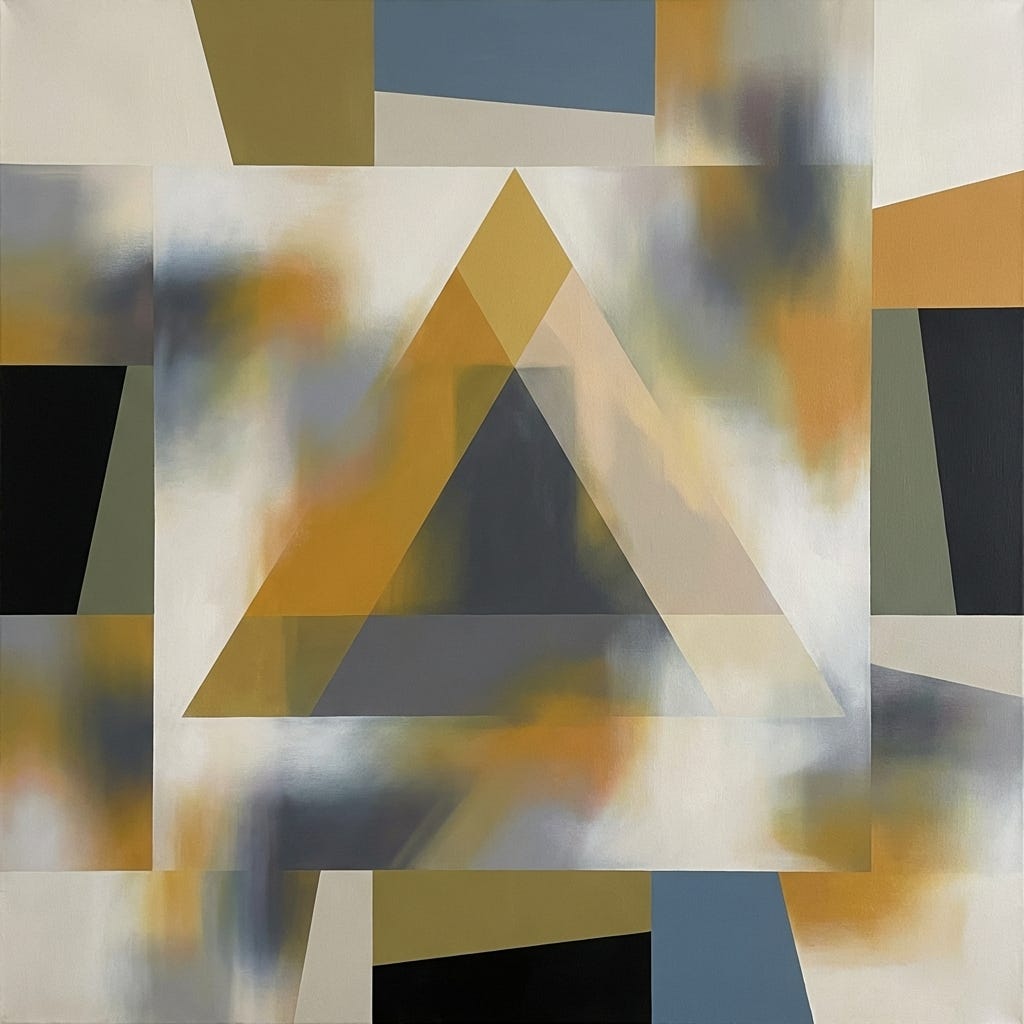
Abstract: How might an alien mind perceive the world? How might an AI? These may seem to be questions we simply cannot answer. But I’ll argue that when it comes to the structure of experience, there’s enormous opportunity to expand our view of what’s possible. I’ll show that experiences can be radically more “sparse” or schematic than we might initially suppose: There can be experiences as of objects that have color, but no particular color; experiences as of triangles that are neither equilateral, isosceles, nor scalene (for the relationships between the lengths of sides and angles are left open). Such experiences have long been taken to be impossible. But while they may be impossible for us, they are possible for the right sort of mind. I’ll introduce a framework for thinking about alien experiencers and alien experiences, drawing on comparative neurobiology, and will use this to argue for the possibility of radical experiential sparseness – a possibility that is particularly relevant to digital minds, who have immense potential for sparse experience.
Humans have long been fascinated by the idea of alien life. As early as Bernard le Bovier de Fontenelle’s 1686 dialogue Conversations on the Plurality of Worlds, writers have imagined what life on other planets might be like, how it might differ from life as we know it, and how it might be shaped in novel ways by alien environments. By the 19th century, there was widespread interest in alien lifeforms, which has continued into present day science fiction and scientific aspirations to discover life on other planets. Why this fascination with alien life? Undoubtedly part of it arises from wondering whether Earth is unique in hosting life. But a part of it stems from curiosity about the possible beings themselves. What might they be like? If they’re conscious, how might they think? Feel? Perceive their worlds? How much variation is there in what sorts of conscious beings are possible? Much as we might wonder about the range of possible worlds, so too, it’s fascinating to wonder about the range of possible experiencers.
Alien consciousness is no longer something that we have to fantasize about finding. With the rise of Artificial Intelligence, it’s plausible that we may soon create alien experiencers. Much has been written about the generic possibility of conscious AI. But very little attention has been given to what sorts of experiences such entities might have. What might it be like to be an AI? Just how wildly different might AI experiences be?
These may seem to be questions we simply cannot speak to. As much as we might know about the physiology of a bat, this can never reveal to us what it is like to be a bat. Likewise, no matter how much we might learn about the physiology of an alien life form – or the architecture of an AI – we will never be able to know what their experiences feel like. Insight into the qualitative nature of alien experiences is clearly impossible: such insight can only be had by experiencing the alien’s perspective “from the inside” – rendering it no longer alien. It’s difficult to see how we could even speculate about alien experiences, beyond postulating their existence.
But while we cannot hope to grasp the qualitative nature of alien experiences, this does not mean that we must remain wholly in the dark concerning experiences different from our own. Part of what makes our experiences feel the way they feel is their structural features. And when it comes to the structure of experience, there’s enormous opportunity to expand our view of what’s possible.
I’ll argue that experiences can be radically more “sparse” or schematic than one might initially suppose. There can be experiences as of objects that have color, but no particular color; there can be experiences as of objects standing in spatial relations to one another, but not any particular spatial relations; there can be experiences as of triangles that are neither equilateral, isosceles, nor scalene, for the relationships between the lengths of sides and angles are left open. Such experiences have been taken to be impossible since at least the 1700s. Enlightenment philosopher George Berkeley made the manifest incoherence of such experiences the cornerstone of one of his most famous arguments – the argument against Lockean abstract general ideas. As Berkeley wrote,
If any man has the faculty of framing in his mind such an idea of a triangle [that is neither equilateral, isosceles, nor scalene], it is in vain to pretend to dispute him out of it, nor would I go about it. All I desire is that the reader would fully and certainly inform himself whether he has such an idea or no. And this, methinks, can be no hard task for anyone to perform.
I’ll argue that such experiences are possible – perhaps not for us, but for some possible creatures. While we cannot have experiences as wild as a triangle with no particular dimensions, I’ll argue that our experiences can exhibit a degree of sparseness. I’ll introduce a framework for thinking about alien experiencers and alien experiences, drawing on comparative neurobiology, and will use this to argue for the possibility of radical sparseness – for the right sort of being.
Also known as the “Just think how close that nearby possible world is where your counterpart is $50k richer!” award.