

Communities, including academic communities, are full of cultural norms. Some of these norms attach valence (good or bad) to different views or beliefs. This creates strong incentives to conform: If you primarily defend culturally-approved views, this helps to establish you as a respectable member of the tribe community. If you defend disapproved-of views, other community members are likely to regard you with suspicion.
Whether this is a good or a bad thing depends on the details. Some views are inherently disreputable (e.g. “Demographic group X doesn’t matter; we can justifiably ignore or trample their interests”), and ought to be stigmatized. At the other extreme, some of our cultural assumptions may mistakenly condemn what ought to be valorized, or vice versa. But perhaps the most interesting case is when a view is regarded as disreputable for essentially correlational reasons: while the view could be held reasonably, there’s a general suspicion that holding the view is (at least statistical) evidence that one is bad or unreasonable in some respect. Maybe it signals vice, but the signal is less than fully reliable.
There are contexts in which it makes sense to follow epistemic shortcuts: defer to elite opinion, vibes, etc. Many people aren’t well-equipped to judge the merits of an issue for themselves, after all. But it remains important that some people assess arguments on their merits, in the hope that we may improve upon the epistemic status quo, and I see this as the role of academics and public intellectuals. Sometimes the vibes are wrong, and it’s our job to figure out when.
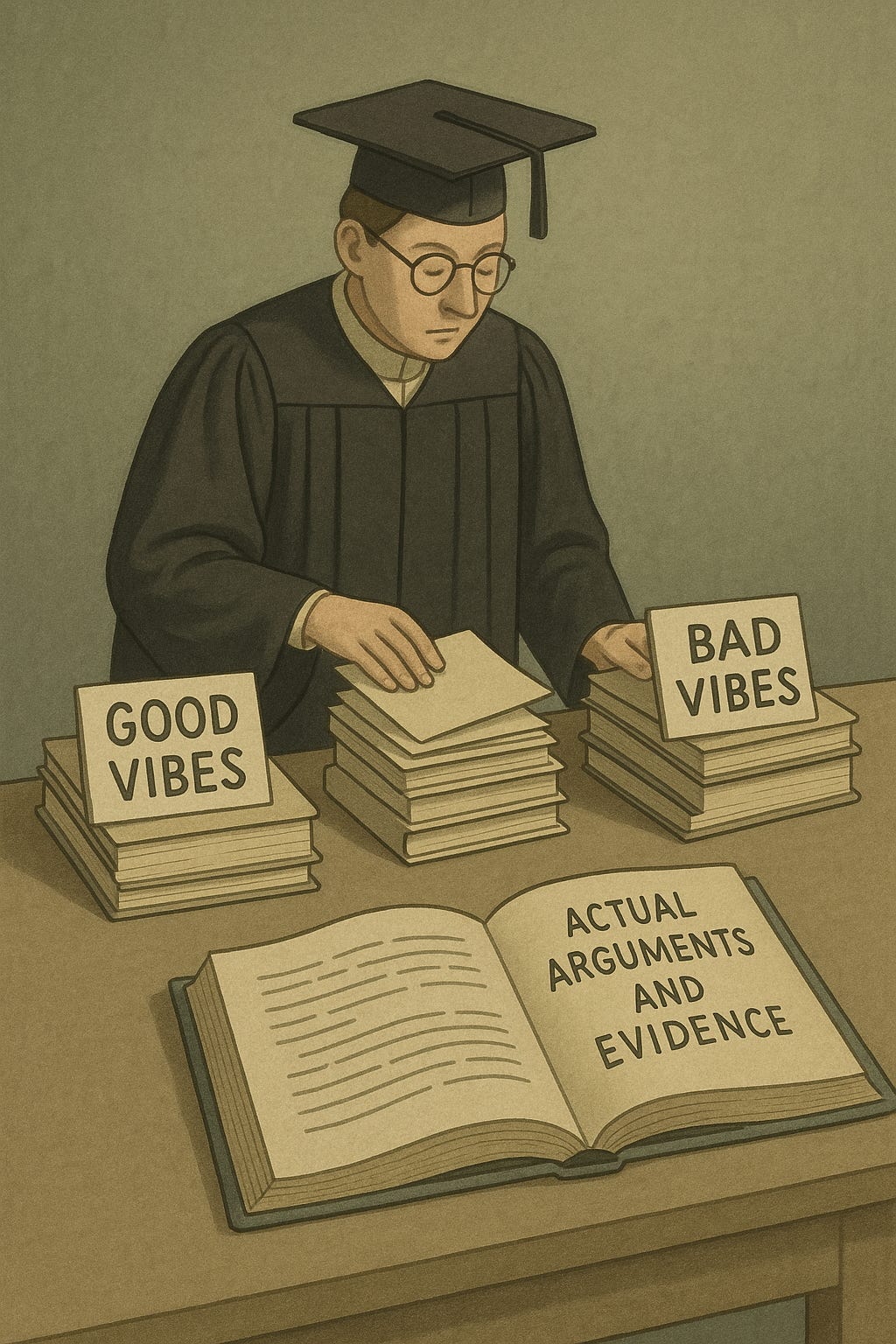
This may be why I get especially annoyed by academics who engage in low-decoupling “guilt by association” tactics, ideological orthodoxy enforcement, and unreflective vibe bias (dismissing rational arguments because the conclusions sound bad). It strikes me as a betrayal of our fundamental mission.
In my view, the academic vocation instead calls for an unusual degree of open-mindedness, willingness to consider ideas that seem obviously wrong on the surface, etc. Not every individual needs to be open to everything, of course: we all have limited time and attention, and there are certainly views where—absent a source I trust vouching for them—I wouldn’t be inclined to waste my time on giving them a closer look. But I guess I do hope that collectively, we ensure that any prima facie reasonable case for a weird view can get a fair hearing from someone, who can then signal-boost it in the unlikely event that closer scrutiny reveals it to be actually well-supported. Broader acceptance, when warranted, may gradually percolate out from there.