

My wife Helen is slightly obsessed with education. One of her childhood hobbies was designing optimal syllabi. Now, when she’s not exploring grand metaphysical systems better than Berkeley’s, she’s planning and researching how to better educate our crazy smart, neurodiverse 8-year-old. I think a lot of the stuff she’s found is rather awesome, so figured I’d share some examples below in case other parents find it of value—or have their own suggestions to share in return!
Background
We do a lot of our homeschooling over meals: I’ve read our son many interesting non-fiction books over breakfast; as a family we listen to (and discuss) history over lunch, and watch (and discuss) science lessons over dinner. It might not work for everyone, but our kid picks up an immense amount this way. It leaves us (Helen, really) only needing to do “formal” lessons—and associated practice, which admittedly can be more tedious—for math and writing.1
Our general goal for these early years is to balance foundational skills (in math and language) with breadth of understanding (science, history, plus hints of philosophy/politics/economics) while nourishing love of learning throughout. It’s basically low-key aristocratic tutoring by a couple of Princeton philosophy PhDs, and seems to be working out pretty well so far!2
Outside of meals, math & writing practice, and social events, our son can basically do what he wants with his time.3 Much is spent in storytelling, crafts, and fiction reading. But Helen has also assembled a pretty amazing non-fiction children’s library for our son over the years, which he puts to good use. He’s learned an immense amount from self-directed reading on whatever topics he’s interested in (everything from plant biology to the Haitian revolution). Whenever he asks questions that go beyond our knowledge during mealtime discussions, Helen replies, “Let me buy you a book on that.” He soon knows more about the topic than we do.
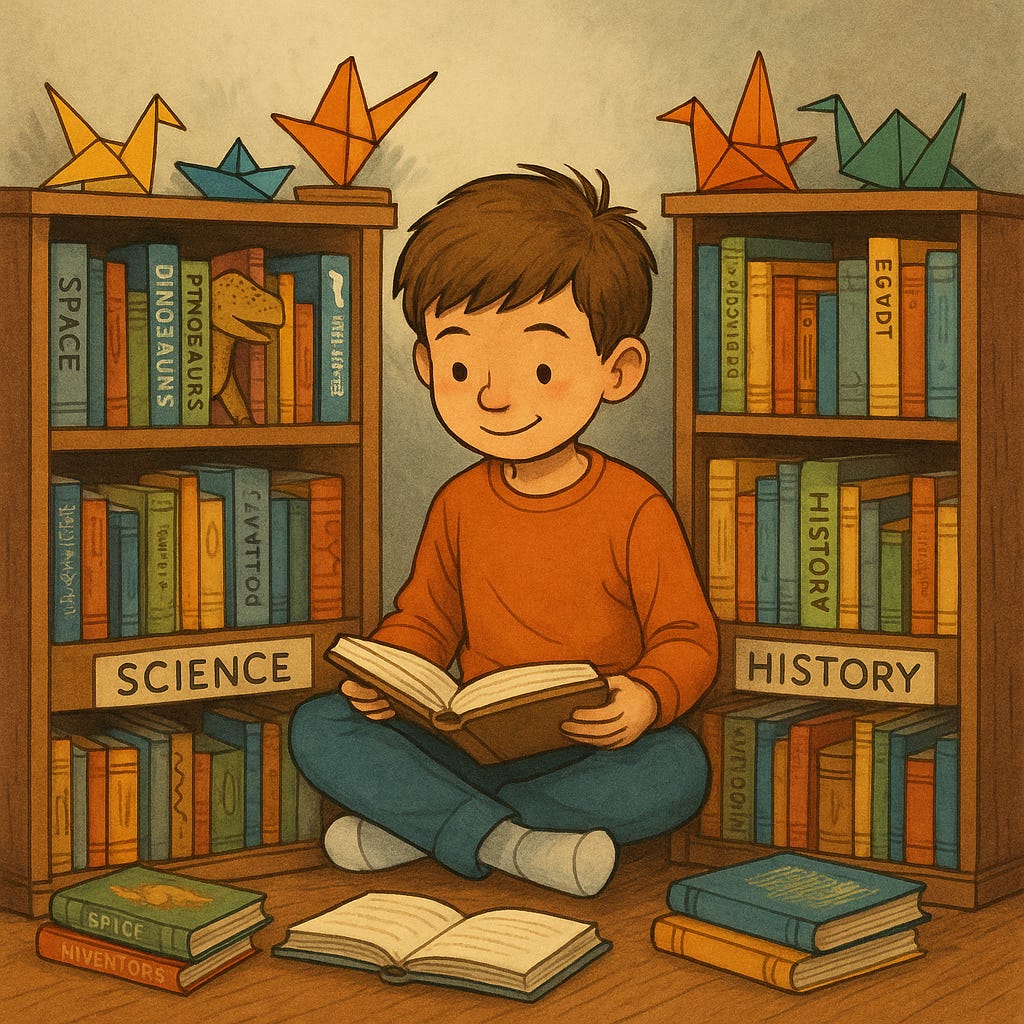
Helen isn’t sufficiently keen on blogging to spend time writing up the details of her lessons (even though, e.g., she developed a unified strategy for teaching spelling, grammar, and writing that seems far more promising than orthodox approaches).4 But let me share some favorite resources (bearing in mind that they benefit from supplemental teaching / shared attention):
Math and logic
Beast Academy - conceptually-focused full math curriculum.
Global Math Project - fun conceptual lessons, e.g. understanding arithmetic operations via exploding dots.
Dragonbox math apps, esp. Elements (Euclidean geometry) and Algebra; genuinely clever rather than just rote learning + glitz like most “educational” apps.
Molly and the Mathematical Mysteries (a fun early book to work through together)
For younger kids: Logic Land and Invasion of the Cow Snatchers are fun logic/puzzle games, and our son got a lot out of the Anno’s Math Games books.
History
History Quest audiobooks (“Early Times” and “Middle Times”) - these are incredibly good, interspersing big-picture history with personalized “history hops” to “meet” a particular individual from the culture and time period that you’ve been learning about.
The Story of the World (vol. 3; just because History Quest: Modern Times isn’t available yet. Note that Helen is less inclined to recommend this one, but it sparked some good family discussions even if the presentation seemed tendentious in places.)5
Foundations of Chinese Civilization (a refreshing change of perspective)
Science
Science Mom offers excellent video “courses” for elementary-aged kids: fun, engaging, and well-explained.
Conceptual Integrated Science Explorations (Grades 7 - 9): these video lectures are a big jump up in sophistication/challenge. The lecturer is a brilliant teacher: the course offers (short, carefully selected) clips from college physics lectures, and our 8 yr-old is able to understand all the conceptual material. (We just skip anything too math-heavy.)
Mr Wizard (fun science demos from the 1960s).6 I like how he interacts with the kids on the show; idea-focused and somewhat understated, none of the overacting or forced enthusiasm that’s so common these days.
MEL Science kits - these are really good. Highly recommended for hands-on learning.
(Various ad hoc book recommendations—many science & engineering related—are included in the “Other” section, below.)
Electronics and Engineering Activities
Spintronics mechanical circuits are an incredible idea that let you actually see and feel current and voltage, and how they’re affected by resistance, series vs parallel constructions, etc. The only problem is that, once the novelty wears off, you can’t really do anything especially fun with the spin that’s generated. Still, highly recommended for developing implicit understanding of how circuits work.
The same people make marble-powered computers that we haven’t tried yet. (Looks cool, though.)
We’ve generally had a lot of fun with Smartivity and KiwiCo kits. (And Legos, of course.) Wintergatan is an inspiration.
Computer Games / Programming
I love computers, and would probably be a programmer if I hadn’t discovered philosophy. Alas, our son shows little sign of sharing my interest here. But a few games he did get into for at least a while were:
Minecraft - highly recommended; builds creativity and planning skills.
Oxygen Not Included - one of my favorite games (alongside Factorio); it’s quite challenging, so probably not feasible for a child to learn themselves. But we had a lot of fun playing it together: my son deciding the big-picture goals for his colony, and me helping him with the details of implementation.
Shapez is a relatively gentle introduction to optimization games.
Quilts and Cats of Calico is a charming cat-themed puzzle game.
Hopefully in future I can get him into grand strategy (e.g. the Civ series, maybe FreeCol since we’ve recently been learning about that period of history, and eventually Europa Universalis—the best way to pick up history and geography through osmosis!)
Plus of course Scratch for beginner programming. (We’ve had some success with this, but I need to tamp down my enthusiasm for complex programming projects or he gets overwhelmed!) Haven’t yet tried vibe-coding together with Claude Code, but hopefully I can convince him to try it someday.
Other
Favorite educational fiction includes:
Abbott’s Flatland (we haven’t actually read this one together yet! Discussed some of the ideas, though.)
Russell Stannard’s Uncle Albert series (does a wonderful job of intuitively conveying the insights of modern physics).
Norton Juster’s The Phantom Tollbooth (fun, funny, and very clever)
Favorite kid-friendly non-fiction authors / series include:
My First Book of Relativity and others in that series from Button books
Steven Johnson (great introductions to select themes in the history of innovation, e.g. How We Got to Now and Extra Life)
David Macauley (charmingly illustrated intros to engineering, e.g. Mammoth Science; The Way Things Work; and City: A Story of Roman Planning and Construction)
Irving Adler (great physics explainers, e.g. Color In Your Life)
Joy Hakim’s The Story of Science is a history of science series that we’re looking forward to, but haven’t started yet.
Recommended biographies and other ad hoc non-fiction suggestions:
The Woman Who Split the Atom: The Life of Lise Meitner - a matter-of-fact portrayal of early 20th century sexism in academia, followed by a relatively gentle (so far; we’re still early in the book) introduction to the horrors of Nazi Germany.
Galileo and the Magic Numbers and Isaac the Alchemist both start in childhood, and our son seemed to strongly identify with the protagonists!
The Forest in the Tree: How Fungi Shape the Earth - fascinating stuff.
The Great Grammar Book by Kate Petty and Jennie Maizels - our son had so much fun reading this (repeatedly), which we found hilarious since it’s a book about… grammar. But they really did amazing job of making it fun.
Favorite educational videos include:
Macauley’s PBS shows like Mill Times
BBC historical documentaries featuring Ruth Goodman & Peter Ginn, e.g. Secrets Of The Castle (How To Build A Medieval Castle From Scratch) and Tudor Monastery Farm.
For younger kids: 3-2-1 Contact offers engaging videos on ad hoc science-related topics.
Conclusion
If people are interested, I may someday write some further reflections on homeschooling (or “home education”—part of the point is to get away from “schooling” as a method). While my wife is extremely enthusiastic about it, I feel more conflicted: positive on the whole, at least for our family, but the parental time costs (passing up the free childcare and socialization provided by public schools) are significant, so I certainly wouldn’t recommend it for everyone.7 Still, for any parents who like to do at least some educational stuff at home, hopefully some of the above resources are of use. Feel free to share your own suggestions in the comments!
I have to confess that it hasn’t gone well when I’ve tried to oversee our son’s writing practice—it felt too much like a battle, and neither he nor I enjoyed the process. Helen has now gotten him to the point where he can often complete his writing tasks without adult supervision, which is much better for everyone.
We don’t make any deliberate effort to discuss philosophy in particular, but it implicitly shapes how we discuss everything else. We’ll highlight implications we find especially delightful; conflations that seem to lead an author into error; ethical assumptions that could be questioned, and so on.
It probably helps that he’s never had unsupervised screen time. A while back he insisted on darning my socks. (Did a darn good job of it, too!) Sometimes he’ll bake us cookies, which is even cooler. (Not everything in our lives is so easy, of course. I’m not talking about the challenges of raising a neurodiverse child in this post, but they do exist.)
Maybe an incentive could change that: if you’d sign up to read a paywalled post by her on home education, leave a comment to let me know, and I’ll try harder to sell her on the idea. (Still unlikely, though.)
E.g. the text would sometimes seem to suggest that historical bad actors (colonizers, etc.) “had” to do various atrocious things in order to advance their interests, rather than presenting their actions as a choice.
I guess they’re trying to avoid moralizing? But it sometimes comes off as presumptively justifying quite reactionary positions instead. It’s an interesting question how one might best present a “neutral” or ideologically unbiased telling of history. I might prefer an approach that more openly acknowledges room for moral questions. Anyway, I was happy enough to read this text as a family because we could always raise those further questions ourselves!
I especially enjoyed the bending light episode. Pausing to discuss part way through, we anticipated the “air lens” idea, and our son soon grasped how it would have the opposite-than-usual effect (as I think of it: a convex air lens placed in water is effectively shaping the surrounding water into a concave lens). When, towards the end, Mr. Wizard revisits how an etched glass bowl lowered into monochlorobenzene (a liquid of equal refractive index to glass) loses visibility of its outer etchings but remains broadly visible in outline until the liquid also fills its interior, kiddo excitedly explained to us: “The glass is already invisible because of the monochlorobenzene surrounding it. What you’re really seeing is the air inside the bowl!” A delightful moment.
I’d generally prefer less-intensive parenting norms that are more conducive to human abundance. Ultra-intensive parenting is a fine personal choice if you’re genuinely enthusiastic about it, but I still wouldn’t want it to be any kind of norm that people are pressured into following.
Fascinating, Richard!
We have loved and appreciated Beast Academy and Science Mom. Our oldest is about to move into the AOPs books whenever he finishes Beast Academy level 5 (sometime this year).
Some other resources that are great:
I don’t use Julia Bogarts’ courses or curricula (yet?) but I loved her book “Help My Kid Hates Writing”.
Every game put out by Math for Love (store on Amazon) is amazing.
I absolutely love Denise Gaskins’ philosophy of teaching math. Her book, Let’s Play Math, changed how I think about the topic.
Reading the Writing Revolution was also super helpful to me for one of my writing-resistant kids.
For teaching typing fluency the video game Epistory was great (recommend using a program to teach correct touch typing format first: there are many out there).
I think Eutopia might be to be reincarnated as Richard and Helen's kid 😩