

Remember when America stood for limited government, checks and balances, and freedom?
People may have wildly different moral views and political/policy preferences, and still manage to live together peacefully so long as they prioritize civic respect over raw power and the imposition of their will over others. Civic respect assures others: “Although you may not get your way today, I am no threat to your most basic rights and interests; another day, you’ll have your chance. We can disagree without being enemies.” A strong disposition towards such respect (prioritizing it over one’s first-order political preferences) is, in my view, the most important political virtue, and foundational to liberal democracy. Notoriously, with growing political polarization has come a breakdown in civic respect and its reciprocal: trust.1
Accountability as the Mechanism of Civic Respect
As a purely structural observation, without casting aspersions on any particular individuals or political teams, we can surely all agree that—human nature being what it is—some individuals enjoy dominating others. Such individuals have an obvious incentive to seek out work (such as in politics or law enforcement) where they will get to exercise such power. If granted arbitrary and unchecked power, we can and should expect it to be exercised poorly, to the detriment of the dominated. They might, for example, kill a woman who was guilty of no crime but merely injured their pride.
Given this obvious possibility, the freedom of the civilian population depends upon various sources of state power (e.g. law enforcement) being checked. Officers must expect that if they abuse their power, they will be caught and held to account. And so it goes all the way up the power hierarchy to the President himself. Civic respect requires institutional enforcement, to secure the trust of those out of power.
Without mechanisms of accountability, our lives are subject to the whims of those in power. Since power positively selects for desires to dominate others, this is—to put it mildly—not a great situation! Like Caesar’s wife, decent leaders strive to be above suspicion, assuring the rest of us that they are subject to such oversight (e.g. an independent Justice department) that they couldn’t get away with tyrannical abuses of power even if they wanted to. When an administration does the opposite—clearing away all checks on their power as Trump so clearly has—the implication is clear: they want to be able to abuse power without consequence.2
When Accountability Disappears
In a span of mere weeks, we’ve seen what unchecked federal power produces. Two innocent Americans killed in Minneapolis while many more are terrorized. High-level officials, rather than expressing regret and ordering independent investigations, have jumped to the defense of the killers and dishonestly slandered their victims as “domestic terrorists”. They have sought to keep all investigations strictly in-house, and of course they’ve already clearly telegraphed what their verdict would be. The only reason we know the truth is thanks to videos taken by brave citizen-journalists exercising their constitutional rights in an environment where this is no guarantee of their personal safety.
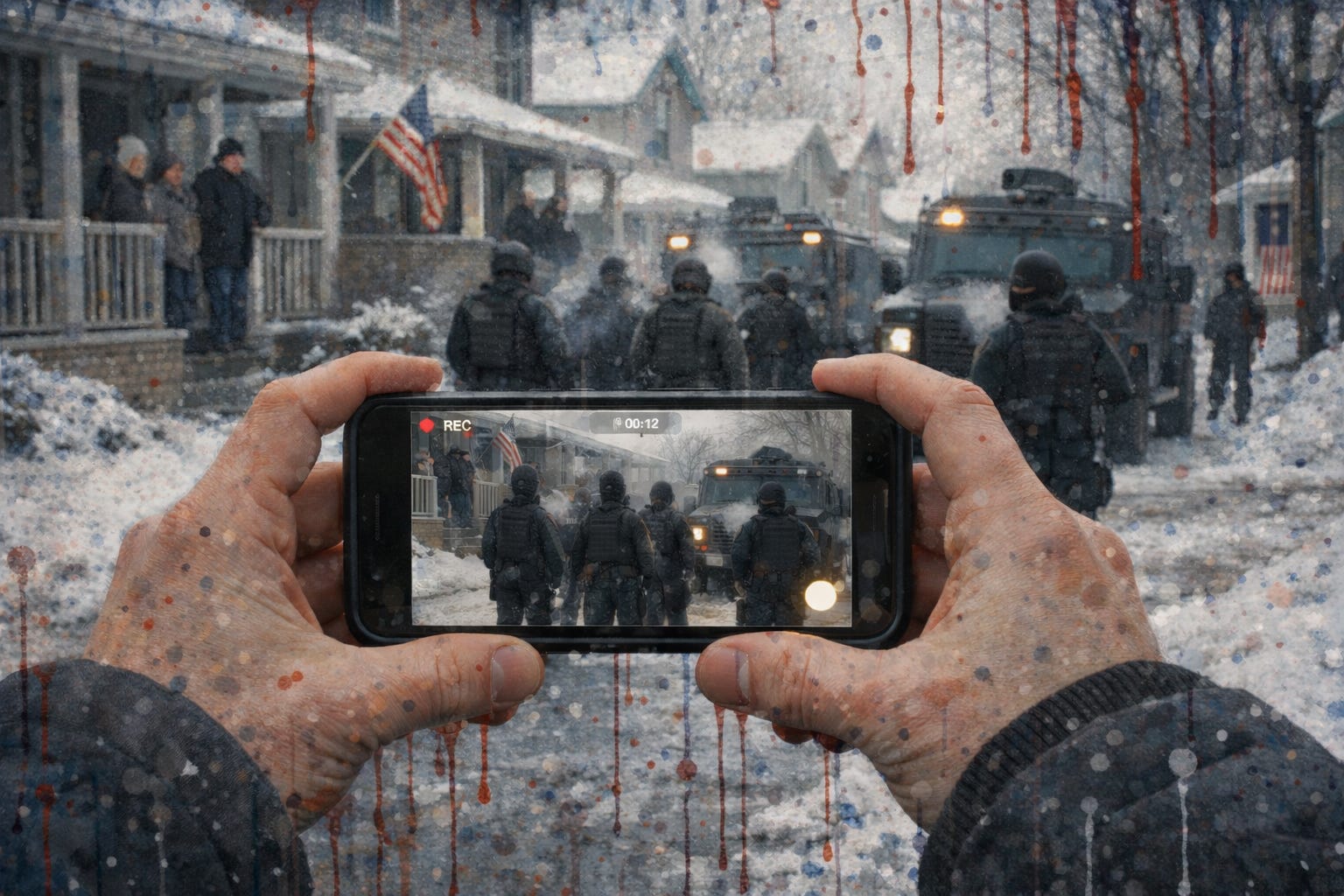
For those of us who do not trust this administration, the clear message is that they can kill us whenever they want, and then simply lie and cover it up afterwards. The administration claims “absolute immunity” for its agents, echoing the Supreme Court’s bestowal of immunity upon the President. That’s a lot of power for even the most temperate of souls to resist abusing. And nobody has ever accused Trump (or those in his orbit) of being the most temperate of souls.
What Norms Should We Want?
I want to return to a more general point about what concrete policies would best embody the civic respect I described at the outset. On the most charitable possible interpretation, the agents responsible for killing Renee Good and Alex Pretti made tragic mistakes out of mistaken fears in the heat of the moment (a moment, note, that they had unnecessarily escalated). The subsequent slander of the victims from administration officials has no charitable explanation, but we’ll set that aside for now.
When law enforcement agents engage aggressively with innocent protestors, they may at some moment experience fear (even if mistakenly, as in these cases). What should we want law enforcement to do in such cases? Many online conservatives claim that the agents are then warranted in killing the civilian in “self-defense”. That seems dubious to me, but I also think it doesn’t matter what’s “warranted” in any such agent-relative sense. What matters is what norms are worth promoting. If some alternative set of norms (call them ‘schmethics’) would serve society better than our current ethical intuitions, then we should adopt those norms instead. So put aside irrelevant moral intuitions and just directly think instead about what’s genuinely preferable.
Now, if we ask on present margins whether law enforcement tends more towards being excessively trigger-happy or excessively cautious and self-sacrificing, this is not a difficult question, right? As a rule, ICE/CBP clearly lean too much towards killing innocent people when they’re “scared”. Consider: how many of them have been killed in scuffles with civilian protestors this month? If most of the fatalities from agent-civilian scuffles were of agents rather than civilians, that would be evidence that agents were not defending themselves with sufficient vigor against the civilian threat. But since none have in fact been killed, and the two civilians killed were (as video footage clearly demonstrates) not actually posing any imminent danger, it seems pretty clear that these agents are being objectively too reckless of civilian lives. If we count agents and innocent civilians equally, killings would be minimized by agents being marginally less prone to kill when scared. Dispositions are influenced by incentives; so it would do good to punish agents more severely (than at present) for mistakenly killing innocent civilians.
We should want law enforcement to be cautious of mistakenly killing an innocent person (just as we should want the courts to be wary of mistakenly convicting the innocent). We should want them to fear punishment if they get it wrong, the same as anyone else would. Moreover, since they have so much power in the situation (including over how and whether to escalate), it may be best to incentivize them to err even more on the side of caution. It would seem in our collective interest, as a public, to demand that public servants—paid by taxpayers to protect our collective interests—be extremely cautious about mistakenly killing us, their rightful bosses. Ideally, they should—like bodyguards—even be willing to take a bullet for an innocent person. At some level of risk expectation you may no longer find enough people willing to take on the job. But moderate shifts in risk could in principle be compensated for by greater pay (like any risky job). And it would have the bonus effect of improving the job’s selection effects, appealing more to those who genuinely want to “protect and serve” rather than to brutes who want an excuse to be violent.
So it seems to me that there’s a strong case, on first principles, for enforcing strict standards on law enforcement against harming the innocent.
The Alternative Vision
The standard move from defenders of ICE/CBP at this point is to deny the “innocence” of (even non-violent) protestors, implicitly claiming that their lives should be valued less than those of law enforcement when it comes to determining these norms. Their view, I take it, is that protestors are impeding the legitimate policies of the democratically elected Administration, and through such interference they waive their usual rights.
One could imagine a state of “Democratic Authoritarianism” where the implicit social contract allowed that democratically elected governments could do whatever they wanted and any protest could be quashed ruthlessly. That seems like a bad system to me—one obvious advantage of constitutionally protected non-violent protest is that it allows for democratic influence and course-correction between elections, in addition to registering the strength and not just raw quantity of citizen preferences. Such authoritarianism is certainly not the American tradition. Whether it becomes so is now being tested.
Some unhinged leftists publicly celebrated the assassination of Charlie Kirk, and now one finds conservatives on Twitter espousing the belief that “The Left” wants them dead. Not exactly conducive to civic harmony! At least no high-level Democrats have endorsed such violence, let alone perpetrated it. It’s important to distinguish online hooligans from the actual politicians (and their underlings) who would wield power.
I’ve tried to write the above section in a way that’s sufficiently neutral that even a staunch Trump supporter ought to be able to agree with it. But when I read articles like this and this, I have trouble wrapping my head around anyone honestly denying Trump’s corruption. He has weaponized the federal government to serve his personal interests and vendettas in a way that ought to be universally recognized as beyond the pale.
This was wonderfully written, thank you. I try to take the advice of many (Bryan Caplan specifically) and consume the news as little as possible. It’s hard to avoid hearing about situations like this, so it’s nice to get a zoomed out analysis instead of a play by play.
Absolutely brilliant. I don't think I've seen this specific take ("let's work from threat perception being real and adjust the reaction to that by using incentives") rather than arguing at other levels. And yet it's *this* specific argument ("he felt scared for his life so of course he was entitled to kill") that has always landed uncomfortably with me as a non-American, because I don't quite align with the idea of "protecting the lives of functionaries of power at the cost of increasing the risks to others, be they general public or even suspects", yet it seems like taken absolutely for granted.