

I think most people have pretty badly misguided moral priorities, which is tricky to argue without making them defensive. (Today I’m going to prioritize clarity, despite this cost.) I generally try to thread the needle by being pretty lax about our positive moral obligations (it’s great to do good, but we all do less than would be ideal, so it would seem a bit unreasonable to hold that against anyone). But I feel much more strongly about (i) the negative obligation to do no harm, violated by those villains who go out of their way to discourage others from doing good effectively, and (ii) our intellectual obligations to try to figure out what’s true, and appreciate better actions whether or not we’re willing to pursue them ourselves. Combining these, I am especially appalled by people who discourage weighing tradeoffs or thinking carefully about the good. I find that behavior so vile, it literally makes my skin crawl.
So I’ve found it very depressing to witness the viral online reaction to a snippet of the recent NY Times profile of Dario Amodei which mentions his guest blog post for GiveWell, as a graduate student in 2010, reasoning carefully about where to donate $10,000 of his grad student stipend. I think this is just about the epitome of moral and intellectual virtue; I doubt many of his critics have done anything nearly so virtuous in their entire lives. Yet the online reaction showed people reacting to this virtue by calling him “a piece of shit”, “arrogant”, “monstrous”, etc. — all because one factor in his reasoning is that he gives 2-3x more weight to saving adults than infants (due to differences in cognitive development).1
It’s difficult to articulate (without cursing) how deeply messed up I find this. Two points I especially want to emphasize:
(1) How to weigh fetal vs infant vs mature human interests in avoiding death is a difficult, deeply contestable question about which people can reasonably disagree. Dario’s particular answer may or may not be correct, but it is certainly within the range of reasonable candidate answers. People thinking it is somehow “beyond the pale” are deeply confused, and haven’t thought enough about the issue.
(2) There’s something extraordinarily vicious about learning about an act of unusual generosity (a grad student donating a large portion of his income to charity, while reflecting conscientiously about how to do so most effectively), and having one’s primary response be extreme negativity and hostility due to some minor (and, as it turned out, outweighed in his final decision) details about the donor’s reasoning.
Weighing Lives
Lots of commentators were quick to assume that Dario’s developmental moral weights revealed a pathology of “EA” or “utilitarianism”, and/or were simply stupid. In fact they match one of the leading accounts of the harm of death, Jeff McMahan’s time-relative interests account (TRIAD):
The strength of a person’s interest at time t in having some benefit in the future, or avoiding some harm, is a function of two variables: (1) the magnitude of the benefit or harm at the time when it would occur and (2) the strength of the prudential unity relations [psychological connectedness and continuity] between the person at t and herself at the time the benefit or harm would occur…
Death is a misfortune for a person because it deprives that person of good life the person would otherwise have had. On the most obvious way of understanding the Deprivation Account, the extent to which death is a misfortune is proportional to the amount of good life of which a person is deprived by death. I have called this the “Life Comparative Account” (henceforth the LCA) because it compares the life a person has that ends in a certain death with the life the person would have had in the absence of that death and then measures the misfortune of death by the extent to which the shorter life is less good than the longer life would have been.
The problem with the LCA, however, is that it implies that the worst time for an individual to die is immediately after that individual begins to exist. Thus, assuming—as virtually everyone does—that we begin to exist at some point before birth, this account implies that the death of a fetus is a substantially greater misfortune for the fetus than the death of a child, adolescent, or young adult is for that individual. But that implication is deeply implausible…
According to the TRIAD, death immediately after an individual begins to exist (whether that is at conception or at some other time during fetal gestation) is hardly a misfortune at all for that individual, since the individual at the time of death would have been connected to itself later, when it would experience benefits and harms, only by continuity of consciousness, if that. The life that an individual loses by dying shortly after beginning to exist is, as Parfit might have said, relevantly like the life of a different individual. Hence when an individual dies immediately or shortly after beginning to exist, that is relevantly like that individual’s never coming into existence at all. On the TRIAD, death gradually becomes an increasingly greater misfortune for an individual as that individual develops and matures psychologically—a process that normally accelerates dramatically shortly after birth—even though as this development proceeds, the amount of remaining good life is gradually decreasing.
It’s fine to disagree with this account, of course. But I think it’s deeply anti-intellectual to be offended by the mere consideration of the possibility that newborns may be harmed less by death than are cognitively developed persons. (One can, of course, combine this view about how to prioritize benefits with strict deontic constraints against harming, regardless.) People who think it’s immoral even to consider a credible answer to an open philosophical question are making a serious mistake.
A common response: “They’re not condemning moral thinking, they’re condemning the specific conclusions that he reached.” But it discourages moral thinking if you condemn people whenever they reach conclusions that are at odds with pretheoretic vibes. If we are to encourage moral thinking, we must tolerate good-faith conclusions that are reached from it, within a reasonably broad range. Maybe some views are “beyond the pale”, and others criticizably stupid, but the time-relative interests account of the harm of death is neither.
Since the view in question is perfectly reasonable and defensible (whether it turns out to be ultimately correct or mistaken), and hostility requires a warrant, it is not reasonable to be hostile towards anyone merely for holding this view.
Vicious Priorities
I find it especially unreasonable to be hostile towards someone for holding this view in the context of reasoning conscientiously about where to send an incredibly generous donation.2 Here’s the response of a writer for The Guardian:
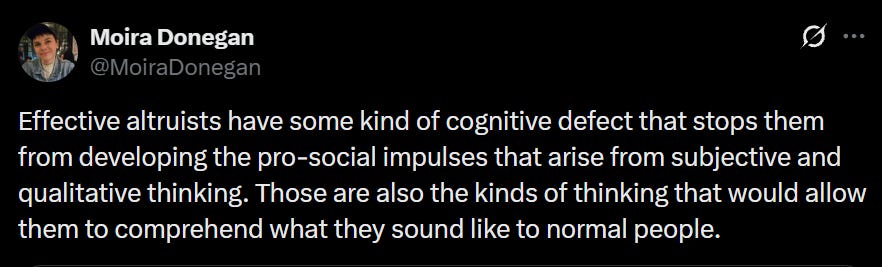
She blocked me when I responded, “I would’ve thought that donating to life-saving charities was pretty pro-social, as is thinking carefully about where to donate and why. Have you considered that the defect may be in those who think less?”
Grad-student-Dario’s donation may have saved several lives, by GiveWell’s estimates. It would have constituted a significant chunk of his income at the time. There are relatively few people in the world who have ever, in their entire lives, done anything so generous. I’d bet most of the dunkers haven’t. In quibbling over his reasoning as he saved lives, while they do nothing of comparable value, the dunkers reveal that they value symbolism over concrete individuals. This is an extremely common vice, and one that I wish people were more sensitive to.
As I’ve written previously, assuming you’re not a serial killer or anything, the largest factor determining your moral virtue is simply how much you (want to) do to improve global well-being. When lives are on the line—as they always are—quibbles over the usual targets of everyday moralizing pale in significance. There are still plenty of smaller-scale ways to reveal better or worse judgment, of course, and smaller-scale instances of good will or ill. But in the same way that it would seem petty and disproportionate to focus on Gandhi’s failings as a spouse (for those with no personal connection to his wife), I think there’s a kind of pettiness and lack of moral proportion exhibited by those who gloss over incredible life-saving efforts to instead focus on quibbles of word choice or minor details of reasoning that one takes issue with.
Sometimes when I say things along these lines, I get the response that “being generous is not a get-out-of-jail-free card for criticism.” Which, sure, if you expose the guy as a serial killer, I’ll stop talking about his donations. But if you’re specifically nitpicking his reasoning about his donations, when you yourself have not donated nearly so generously to any comparably good cause, then I really think you lack the moral standing to issue those criticisms. There’s a mighty big beam in the eye of people who do nothing for the global poor calling out someone who did a lot for sounding insufficiently “caring” during the process! How much concern can you seriously claim to have if you’ve never donated a cent? Who comes closer to treating African infants as their moral equals: one who donates thousands of dollars to them after counting their interests as a third to a half as weighty as an adult, or someone who doesn’t even consider donating to them, but merely uses them as props for social media dunks?

I find it so upsetting. The world is a mess, and our best shot at making things better is to (i) seriously care about outcomes, and (ii) seriously think about what we can do (with our limited moral resources) to best improve things. Few things are more virtuous and praiseworthy than conscientiously exemplifying those two traits of caring and thinking in service of beneficent action. And while there are worse things than mistakenly condemning these virtues as vices, I suspect that few of them are so common. Discouraging moral thinking (including, yes, good-faith attempts to quantify the relative weights of competing considerations) may be among the worst vices that are commonly exemplified by the sorts of people I interact with. They’re not violating human rights or breaking any laws. But what they are doing is nonetheless quite awful, and I dearly wish they would reconsider.
Realistically, I guess many people are not so much reacting to the substance of the quote but rather just expressing their hostility to powerful tech CEOs, in a “low decoupling” fashion. I also think that is lousy, and people should focus their criticism on things that are actually criticizable. But enough people doubled-down on criticizing the “calculative” reasoning that I think it’s worth addressing.
Claude responds:
In fairness to the dunkers, most met this as a single decontextualized line about a now-billionaire AI CEO—stripped of the generosity surrounding it, and of the fact that he ended up giving the money to the infant-vaccination charity anyway. “Counts infants at a third of adults” reads, out of context, like a confession of coldness, and it’s reasonable to be wary of coldness in people who wield enormous power. That explains the reaction. It doesn’t excuse it. Anyone prepared to publicly call a stranger “monstrous” thereby incurs a duty to spend thirty seconds checking what he actually said and did.
What you fail to recognize is that because most people don't think carefully about how to do good, and don't make large personal sacrifices in doing good, someone who *does* do that is trying to be better than others, which is actually the worst thing one can do.
Everyone knows that to be a good person you shoudn't do much good at all, lest your flower rise above everyone else. One *certainly* shouldn't try to do tons and tons of good, or God forbid try to do the *most* good, because nobody is special or better than anyone else in any way.
You would do well to remember the Law of Jante, which is the foundation of harmonious society and the ultimate expression of the good life:
You're not to think you are anything special.
You're not to think you are as good as we are.
You're not to think you are smarter than we are.
You're not to imagine yourself better than we are.
You're not to think you know more than we do.
You're not to think you are more important than we are.
You're not to think you are good at anything.
You're not to laugh at us.
You're not to think anyone cares about you.
You're not to think you can teach us anything.
You scooped my article tomorrow!