

After Trump’s Department of War tweeted its opposition to effective altruism, there was suddenly a lot of social media discourse about EA.
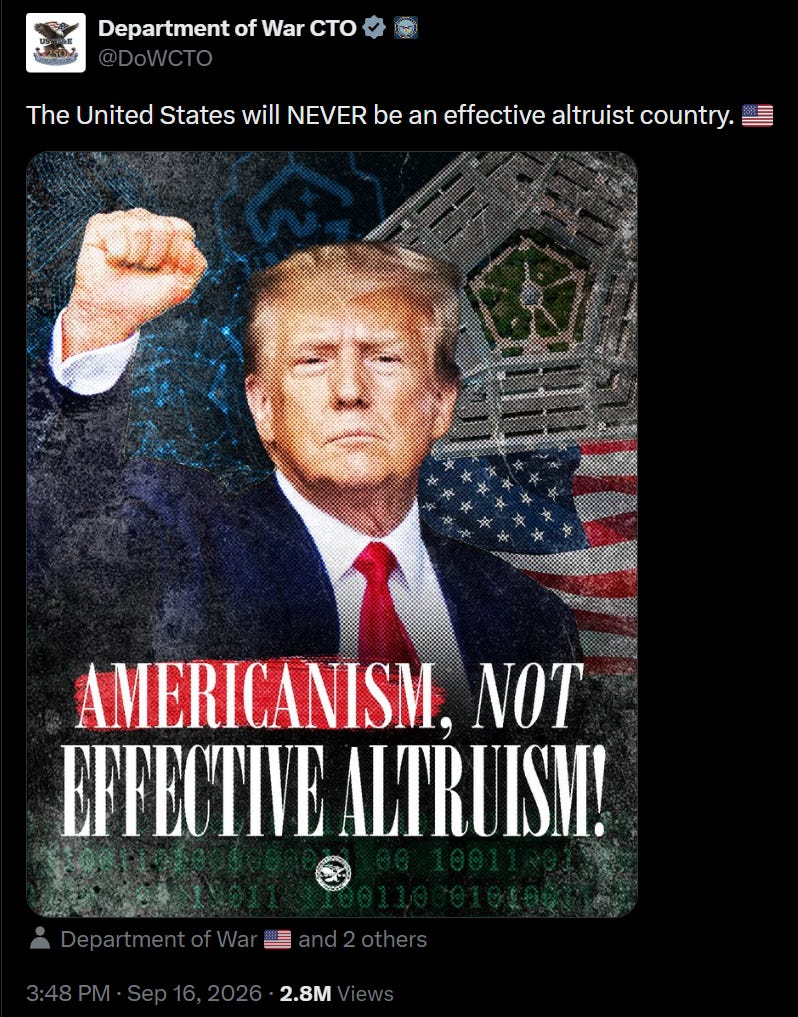
Much viral mockery focused on (i) Dylan Matthews’ Vox post on how the cost of repairing Notre Dame could instead have saved 47,500 lives; (ii) Bentham’s Bulldog’s post on the aggregate importance of insect welfare or (iii) an AI-generated parody of longtermism.
The first prompted philosopher Jennifer Frey to describe scale-sensitive beneficence (which she mischaracterized as “consequentialism”) as “rot”. The last inspired Brian Leiter to declare EA “an embarrassment to philosophy” (a remarkably unphilosophical attitude to take towards some of the deepest puzzles in ethics — how to coherently extend beneficence and decision theory to extreme cases — but I guess there’s no accounting for taste). Christopher Frey implied that the work of (some? all?) EA philosophers was “neither true nor good.”
I doubt any of these insults could withstand an extended critical dialogue (or even just, say, reading my paper). But they are, sad to say, par for the course when it comes to how many philosophers talk about effective altruism on social media. This seems messed up. As my paper argues, there’s room to dispute the specifics, but the core ideas or principles are about as close to indisputable as moral claims can be, while at the same time remaining extremely (almost universally!) neglected in practice.1 Or as Andy Masley recently put it:
When people first hear the basic argument for “effective” giving, that we should direct our donations wherever they save the most lives, their reaction is often “That’s so obvious, why would you even need a special name for that?” It may seem obvious, but almost no one does it, anywhere.
Many make misguided motte-and-bailey accusations at this point, and thereby miss the substantive point. More people really ought to endorse and act upon the neglected truisms of effective altruism, even if they reject our more controversial claims!
It’s worth encouraging people to attend more to reasons of scale-sensitive beneficence, and to use reason and evidence rather than just vibes or untutored intuition to determine how to target their moral efforts most effectively. If you don’t often think about moral prioritization, there’s likely low-hanging fruit available by which you could significantly increase your moral impact at minimal personal cost.2
Scott Alexander has described effective altruism as a “tower of assumptions”, where even if you knock off the top few floors, more foundational ones remain standing.

The way I think of it: there are many different streams of effective altruist thought, and no objection that targets them all simultaneously.3 So it’s a mistake to assess “EA thought” as if it were a single, monolithic thing. It’s much more modular than that. Even if you have objections to how “expected value”-loving longtermists reason about tiny probabilities, or how Rethink Priorities’ Moral Weight Project balances human and non-human welfare,4 there are almost certainly a lot of remaining insights from EA thinkers that you could and should take on board, to end up in a place that’s broadly “EA-adjacent”.
In this post, I’ll highlight a few that stand out to me:5
We have strong moral reasons to donate to effective charities—and, more generally, to seriously try to improve the world in an efficient, goal-directed way. We should all want more people to (i) make this a personal priority (i.e., endorse beneficentrism and take the🔸10% pledge if they can afford it) and (ii) encourage others to do likewise.
Beneficent endeavors vary so much in cost-effectiveness that it’s worth trying to distinguish top-tier options. It isn’t immediately obvious how best to improve the world, so it’s very helpful to have researchers like those at GiveWell look into these details for us.
Many common—and apparently intuitive—evaluative heuristics (e.g. assessing charities based purely on accounting metrics like “overhead costs”; or catastrophizing trivial contributions to salient collective harms while neglecting worse but less-salient ones) are simply no good. It’s extremely helpful to have a community of inquirers reflecting critically on which heuristics actually work in pursuit of better outcomes.
Moral status depends on what a being is like, not how appealing we personally find them. But our gut moral judgments are driven by emotion (especially sympathy), which is predictably biasing. We should all appreciate that activating our sympathy is not necessary for moral status: ugly goblins could still matter morally, even if we found them aesthetically repulsive. Children out of sight matter just as much as those who enter our field of vision (or appear in the news). Abstract benevolence is a vital corrective virtue in light of this bias.
Most people are excessively conformist, fail to appreciate the moral significance of scale, and as a result also overlook the extremely strong reasons to care about non-human animals (especially the less cute ones) and existential risk mitigation.
More generally, we should expect that—as has always been the case in the past—there are ongoing moral catastrophes that conventional thinking is blind to, but that careful reasoning with an eye to stakes-sensitive impartial beneficence may help us to identify early.
Lots of people finally getting on board with AI risk previously mocked longtermists for
thinking ahead“indulging in sci-fi fantasies”. Examples like this (and Peter Singer’s pioneering work on the moral status of animals, or the early utilitarians for that matter) provide some inductive evidence about the value of the “EA toolkit” for getting ahead of the curve on identifying the most important yet neglected causes. (Doesn’t mean we have the solutions, of course, which is why it would’ve been nice to have more people willing to think seriously about these issues earlier.)Assessing major policy issues with an eye to stakes-sensitive impartial beneficence (or cost-benefit analysis) is like a superpower for improving policy analysis, relative to unprincipled vibes that are driven largely by social desirability bias. (See also: theory-driven applied ethics.)
EA forces us to acknowledge the reality of tradeoffs, which is a crucial first step for better navigating them. Estimated quantitative comparisons can be especially helpful, though of course one needs to take care with how these are used. (Again, none of this guarantees we get the answer right. But the question of what to prioritize is the right question to ask, and too often neglected or even denigrated by others.)
Moderating radical conclusions
A good general habit of thought, when you come across a moral thesis that just seems “too extreme” for you to accept, is to ask whether your moral perspective could be improved by taking on board a moderated version of the claim.
This is how we get moderate beneficentrism and the🔸10% pledge as a response to Peter Singer’s radical demands in ‘Famine, Affluence, and Morality’. As many philosophy professors have surely experienced, it can be a frustrating article to teach, because so many students respond as though saying “it’s a bit extreme” establishes that there’s nothing to learn from the argument. But it can challenge us to revise our views—and behavior—even if we don’t go all the way to Singer’s conclusion.
Alas, many people seem determined to not learn anything if they can possibly help it. They treat arguments as threats or enemies to be dismissed. Many of the Twitter responses to BB’s insects post seemed worried that EAs would be willing to wipe out humanity for the sake of bugs. That would be worrisome! Obviously we shouldn’t do that. But as I wrote in The Train to Crazy Town, we can implement a mix of guardrails and “worldview diversification” strategies (like splitting resources between different “sub-agents” representing different worldviews) that together mitigate the downside risk of speculative reasoning while still securing massive potential upside (for protecting against neglected moral catastrophes) compared to conventional thinking.
In short: the practical lesson of speculative reasoning about insects is not that we should fanatically wipe ourselves out for their sake, but that given the sheer scale of what’s at stake, we should surely dedicate marginally more resources to research insect sentience (e.g. whether they experience pain, and how tractable it would be to reduce any pain they might feel) rather than entirely neglecting their (possible) interests.
People similarly love to dismiss longtermism by focusing on its most radical forms, while neglecting the practical significance of more moderate versions. As I wrote in my review of What We Owe the Future:
Because it’s targeted at a general audience, the book doesn’t probe at edge cases or test longtermist principles in extremis in the way that academic philosophers might prefer. So, don’t expect discussion of whether it would (in principle) be worth torturing everyone alive today in order to reduce extinction risk this century by some tiny fraction of a percentage point. (If you’re after this sort of pure philosophy, see ‘The Case for Strong Longtermism’, Bostrom’s ‘Astronomical Waste’, or Beckstead & Thomas’s ‘A paradox for tiny probabilities and enormous values’.) Instead, this book sensibly focuses on the urgent yet undeniable point that we really ought to take greater care not to wipe ourselves out (or otherwise neglectfully slip into a bad long-term trajectory).
Like many of the most important claims in practical ethics, this shouldn’t be controversial, once it’s drawn to our attention. But it does involve a major change in mindset. So the real value of the book, as I see it, is to bring this basic moral insight to our attention, and guide us in applying this lens to see things in a new light.
It’s very common for critics to hallucinate that the purpose of longtermism is to justify violating moral constraints. This is dopey, for reasons I’ve explained in posts like Stakes Can Be High and Astronomical Cake. (In short: justified constraints represent our most reliable procedures for maintaining social cooperation and promoting the good over the long run. Otherwise, moderate deontologists couldn’t explain why, e.g., political assassination is a bad idea: the stakes are surely high enough to exceed any moderate deontic threshold.)
The real practical significance of longtermism is simply to raise the priority of preserving and advancing human civilization relative to other worthy ends like reducing animal suffering. There are lots of worthy moral goals floating around, but existential risk mitigation may be the most neglected in comparison to its objective importance. (And remember, you can endorse this practical conclusion even from a position of broad agnosticism about the precise risks. It’s bizarre how many people get hung up on arguing against the “doomer” position that extinction risk this century is over 50%. The important practical question is simply whether the risk is negligible or non-negligible. If the latter—and tractable interventions can be found that are unlikely to backfire—then we obviously ought to be doing more about it!)
What are you assessing, and why?
There are many different questions one could ask about effective altruism. The one I’m most concerned with is:
First-personal guidance: Can I learn anything from these ideas that will help me to make morally better decisions and/or do more good in the world?
For almost everyone (who hasn’t already thought for thousands of hours about beneficence and effectiveness), the answer is surely “yes”. This post alone is full of neglected ideas that most people would benefit from taking on board to a greater extent, and I’m just listing these off the top of my head: it’s far from an exhaustive survey of what one might learn from the broader EA community.
I don’t think I’ve ever seen a critic ask this question. But what question could be more important for you to ask than what is the lowest-hanging fruit available for me to make better decisions? Perhaps the best question you could ask about any moral framework is how it could help in this way. But many people seem more interested in some form of:
Group evaluation: Do I find EAs as a group likeable and sympathetic? Do they seem like weirdos? Would it be socially embarrassing to affiliate with them? Can I score status points with my in-group by attacking them?
I find these questions much less interesting, so I’ll just reiterate the familiar point that it doesn’t matter whether you identify as an EA. What matters is whether (some of) the ideas and principles are helpful. Perhaps a better question in this vicinity is:
Political evaluation: Will EA ideas tend to make others act better or worse? Should we trust EAs with power?
I don’t think you should blindly trust anyone with power. I’m a fan of liberal rights for this reason. Checks and balances are important. EA is a big tent, and I have significant disagreements with some corners of it.6
I also think we should be worried about Machiavellian sorts who follow a naive instrumentalist decision procedure. (SBF’s fraud was clearly very bad, and plausibly falls under this umbrella. Other EAs have been very vocal about opposing such norm-breaking or illegal behavior.) Many people confuse naive instrumentalism with consequentialism, and then further confuse consequentialism with effective altruism, and so this double confusion may make them misperceive effective altruism as encouraging bad acts. Again, it’s always worth thinking clearly and identifying where the real problem lies. We can then target it more effectively (e.g. with strong social norms against naive instrumentalist reasoning), and with less unnecessary collateral damage.
Conclusion
Impartial beneficence and cost-effectiveness are both gravely underappreciated. On current margins, everyone should want to see more rather than less of these good things. (This could be expected to save a lot of lives, and generally do immense good.) So it’s worth advocating for rather than against them. You don’t have to like effective altruists, or accept their most speculative conclusions. But you almost certainly should think more about prioritization, rely less on gut feelings when drawing moral conclusions, and care about doing more rather than less good. Remember that the numbers we talk about bottom out in real people (or other moral patients), and their lives or well-being can depend on our choices.
You can still send your kids to good schools, for example. We’re not into gratuitous solidaristic sacrifices of the sort that some other ideologies seem to encourage. If you want to help a failing public school, you could presumably choose to do so without sending your own kid there. I guess it’s intended as a commitment device for people who can’t otherwise be trusted to do anything altruistic for groups to which they aren’t personally connected. But I’d rather we found alternative commitment devices and social incentives that don’t require sacrificing our kids!
The “anti-quantification” critics are perhaps more sweeping, but I can’t discern any argument in their work that would justify not caring about whether more or fewer children die of preventable causes this year.
I’m also skeptical of this one’s verdicts, though it’s impressive work and I’d like to see more people attempt such a project.
See also What “Effective Altruism” Means to Me.
There seem to be a disturbing number of negative utilitarians, for example. I worry that their values mandate destroying the world if they could, but I see that as a reason to push back against negative ethics specifically, rather than against the broader idea of trying to effectively improve the world.
When people complain about longtermism, insects, etc., isn't it better (in most cases) to tell them to donate to public health, rather than argue about the merits? Obviously your Substack audience is another matter.
That eha tweet and accompanying city journal article confused me a bit up until I read the part about how we should get rid of USAID because hey, you don’t know those people, so their moral worth to you isn’t much.