

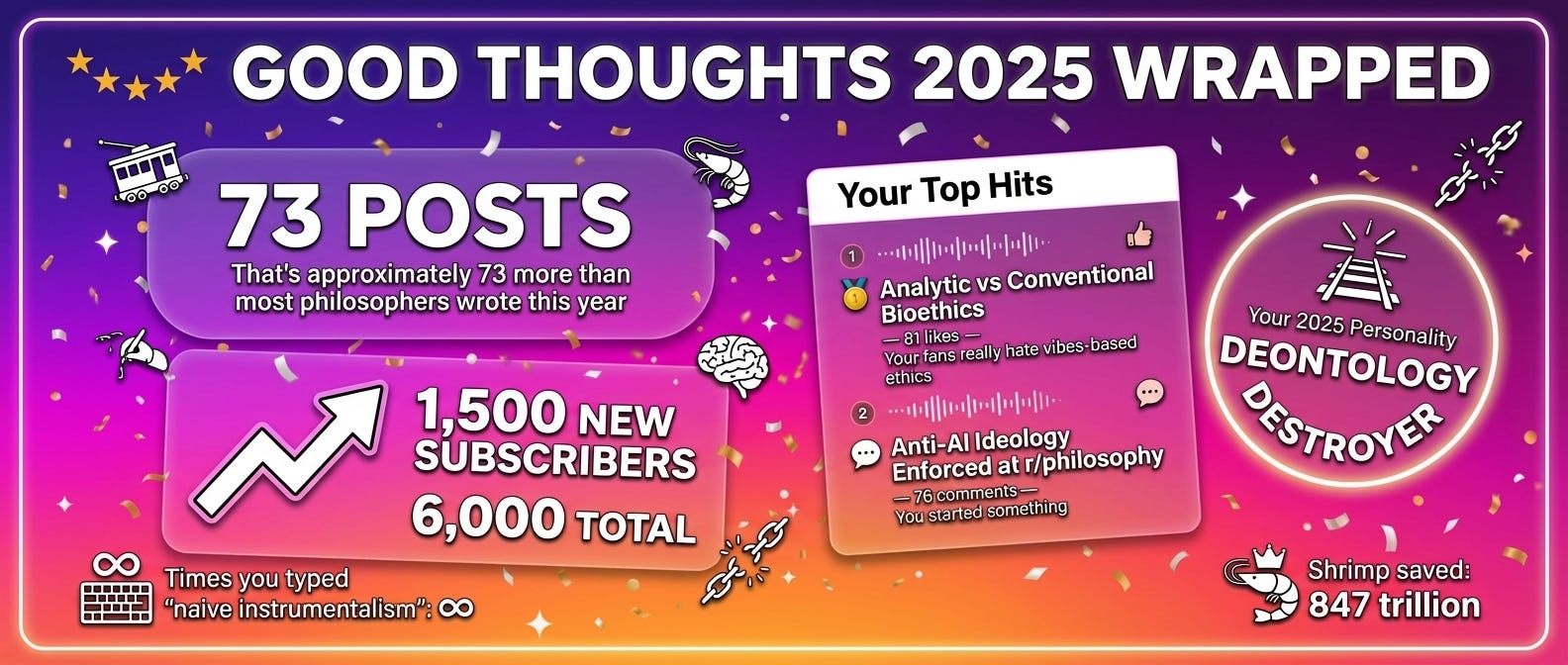
Another year, another 70-odd posts and 1,500 new subscribers. It’s great to have you all here! My posts are summarized below,1 bolding those I most recommend to anyone who missed them the first time around.
Feel free to comment on any old posts that interest you. Or start a new conversation in the subscriber chat—the readers here are a fantastically nice & thoughtful bunch!
Politics, Policy, and Polemics
Analytic vs Conventional Bioethics – Intellectuals should do more than launder vibes.
Vaccine Obstructionism Kills – The FDA kills far more people than vaccines do.
A Pox on the Culture War – Against both wokeism and anti-wokeism. Principled liberalism rejects culture war tribalism from either direction, focusing on more important issues.
Diversity, Merit, and Distrust – Comparing arguments for demographic and intellectual diversity.
What’s Wrong with Collaboration? – Against the argument from cooties.
Academia and General Philosophy
A Quick Fix for the Referee Crisis – Journals should charge (hefty!) submission fees and use the money to pay referees.
The View from Everywhere – Highlights from Helen’s idealism book, published this year by Oxford University Press—“a must-read for two (admittedly rather niche) audiences.” I also had fun making a theme song for it.
Philosophical Pattern-Matching – The struggle to replace philosophical stereotypes with substance.
Vibe Bias – some positions get an easier ride due to superficial appeal.
Levels of Moral Explanation – Exploring how many levels of moral explanation we should expect, distinguishing substantive vs. procedural second-order explanations.
Modal Rationalism – Intro – On our grasp of possibility: introducing my (2006) undergraduate honours thesis. (I think it’s held up pretty well!)
Kripke vs 2-D Semantics – Part 1/3 of my Modal Rationalism series: “My sense is that the vast majority of philosophers have wildly inflated the metaphysical significance of the Kripke-Putnam necessary a posteriori, and could benefit from learning about the Jackson-Chalmers counterpoint explained below…”
Critiques of Deontology
The Curse of Deontology – Summarizes the key ideas and arguments from my recently-published paper, ‘Preference and Prevention: A New Paradox of Deontology’: either deontic normativity is “quiet” (no-one can want others to successfully follow it), or deontology is false.
Deontologists Shouldn’t Vote* (unless their vote would help prevent an even worse outcome.) Quiet deontology implies, surprisingly, that deontologists should prefer to let consequentialists rule the public sphere.
Only Aggregationists Respect the Separateness of Persons – Separate people have independent value; the common objection gets things backwards.
Death by Metaphysics – How badly would it suck to die because someone prioritized abstract metaphysical distinctions over real human lives?
Inviolability and Importance – Kamm vs. Kagan on maximal moral status; why I don’t think there’s any good reason to prioritize “inviolability” as a status marker.
Moral Self-Indulgence – On prioritizing expressing your values over actually promoting them; why distinctively deontological approaches to policy are suspect.
Seeking Radical Deontology – Principled deontologists should be at least as concerned about status quo harms as utilitarians are.
Ethical Theory
Moral Intuitions Track Virtue Signals – Our moral intuitions aren’t tracking intrinsic features of actions but subtle signs of good vs. bad character.
Shuffling around Expected Value – A simple proof that we should often maximize expected value: with rare exceptions, moving people around in probability space shouldn’t matter.
Moral Theories Lack Confidence – Be careful how you personify them; people, not theories, should be uncertain about the hard questions.
Autonomy Consequentialism – Maximizing respect for others’ self-regarding preferences.
In Defense of Stakes-Sensitivity – Competing conceptions of beneficence seem poorly grounded.
How to Think about Collective Impact – Universalizability done right.
Thoughts on Tucker’s Best Self – Reflections on right-making features and fittingness.
Population Ethics and the Value of Life
The Gift of Life – Against anti-natalism: life can be good, and it’s often worth bringing about good things.
Why Depopulation Matters – Review (#1/2) of After the Spike: why we should be worried about below-replacement fertility.
A Human Abundance Agenda – Review (#2/2) of After the Spike: what (not) to do about depopulation, and how to make parenting more appealing.
The “No Duty → No Good” Fallacy – Just because something (whether procreating or donating a kidney) isn’t obligatory doesn’t mean it isn’t good.
Don’t Void Your Pets – Good life is good, for animals too. It doesn’t do them any favors to prohibit them from experiencing good-but-imperfectly-autonomous lives.
The Costs of Permission – Against requiring “parent licenses”: we should shape the choice environment to make it easier to do good things.
Applied Ethics and Effective Altruism
The Moral Gadfly’s Double-Bind – Warranted moral criticism is rarely welcomed; we should accordingly watch out for do-gooder derogation.
Facing up to the Price on Life – It shouldn’t be so easy to save a life, nor to ignore it; on honest compartmentalization vs. moral delusion.
Limiting Reason – A principled middle ground between “easy dupe” and “dogmatism”: let your mind roam free, but be cautious about acting on fragile beliefs.
Subagents for Shrimp – A moderate’s case for worldview diversification: create mental “subagents” to represent different cause areas, and protect against undue neglect.
Trade-off Denialism – When, exactly, should we prioritize the arts over saving lives? Critics should own up to the costs of their proposals.
How to Save the World (in theory) – a two-step schema for moral perfection via cooperative consequentialism.
Rule High Stakes In, Not Out – Why arguments that a high-stakes hypothesis is unlikely (but not negligibly so) may make surprisingly little rational difference.
Optimizing Differently – Why the “diversification” objection to optimizing one’s charitable giving is confused.
Inconsistent Anthropocentrism – Animals < Humans < Nature?
The Worst Person Who Ever Lived – Is an unknown American woman.
AI and Tech Ethics
There’s No Moral Objection to AI Art – the free portion explains free vs. permission culture, and why “pirate” training of generative AI is plausibly fair use. The debate should focus on what IP rights regime best serves the public interest, rather than fetishizing intellectual property for its own sake.
A.I. Changes Everything – Explains my sense that “our top priority should be to learn more, fast.” This post shares some initial (already out of date!) recommendations for familiarizing oneself with AI capabilities, and invites general discussion of how to prepare for future changes—both good and bad.
Anti-AI Ideology Enforced at r/philosophy – On mods abusing power to impose their personal ideology, and why blanket anti-AI policies are unreasonable.
Philosophical Incuriosity (AI edition) – How political blinders hinder thought about AI.
Human Misalignment – An immediate danger from AI: getting what we want?
Compatibilism for Claude – on the incoherence of pure self-creation.
Discussions, Interviews, and Media
Marginal Persuasion – My interview with Jason Chen argues that the world needs more effective altruism.
Ethics Discussion with Daniel Muñoz – a friendly discussion on consequentialism vs. deontology, hosted by Bentham’s Bulldog.
Excellent New Substacks – Recommending new philosophical Substacks from Greco & Wansley, Daniel Muñoz, Victor Kumar, and more.
Philosophy Video Explainers – A three-part video series introducing key utilitarian ideas, plus a YouTube playlist of all my online interviews and talks.
Can Songs Philosophically Convince or Illuminate? – Perhaps by making an alien perspective more emotionally vivid? My best attempt is a fun but rather over-the-top Suno production in defense of the value of Parfit’s world Z.2
More interviews: at Philosophy and Fiction, Why Philosophy?, and Salvador Duarte’s podcast.
Miscellaneous
Home Education Resources (for gifted kids), courtesy of Helen’s in-depth research.
Utilitarianism.net Updates Again – Likely the last major update. Includes Animal Liberation study guide, additional minor objections, and four new guest essays.
How to Create a Paywall-Bypass Link – For your own Substack posts.
Bonus Paywalled Articles
N.B. I’m donating 100% of December revenue (including full annual subscriptions received or renewed this month) to GiveDirectly, helping families in Rwanda. Subscribe now to do more good :-)
There’s No Moral Objection to AI Art – the full version includes further thoughts on the general moral orientation that leads people to demand permission as a prerequisite to AI training.
Meta-Metaethical Realism – Could anti-realism be objectively true?
Vibe Bias – some positions get an easier ride due to superficial appeal.
Creepy Philosophy – What candidate truths do you find most disturbing?
Wenar-MacAskill Philosophical Cagefight – Embarrassing for just one of them!
Sacrificing Individuals for Symbolism – seems bad (yet sadly common)!
The Fairness Trap – Against zero-sum thinking.
Who Should Direct Social Spending? – Individuals, corporations, or governments?
Seeking Radical Deontology – the full version includes more extended discussion.
From Autonomy to Utility – Deontology as defection; the case for waiving non-utilitarian rights. (An excerpt from my book manuscript-in-progress.)
Thinking Clearly about Reasons – Why practical reasons for belief are like reasons for chocolate. (An excerpt from my book manuscript-in-progress.)
Death isn’t (absolutely) bad – But life is better (so death is comparatively bad).
Theists should be Idealists – I’m neither a theist nor an idealist. But my conditional probability for idealism given theism is high.
Meta-Modal Conceivability – Answering Yablo’s challenge for conceivability-possibility inferences. Part 2/3 of my Modal Rationalism series.
What is Metaphysical Possibility? – Part 3/3 of my Modal Rationalism series.
If you’d like to support my work but find the regular price too steep, you can—this week only—get 50% off with this coupon.
Conclusion
Thanks for following Good Thoughts! Feel free to post requests or general feedback in the comments below. If you’re new this year, you might also find some articles of interest from 2024, 2023, 2022, or my prior 18 years of blogging at philosophyetc.net.

Happy New Year!
Let me know if you spot any broken links. (Since it’s a purely logistical task, I had Claude assemble the initial list for me, but I did notice a couple of broken links that needed fixing.)
Variously described as “a banger”… or in, ahem, less glowing terms… depending on who you ask.
Congrats, and good on you for being so generous with your revenue!
*sigh* Fine I'll read another 10 of your articles